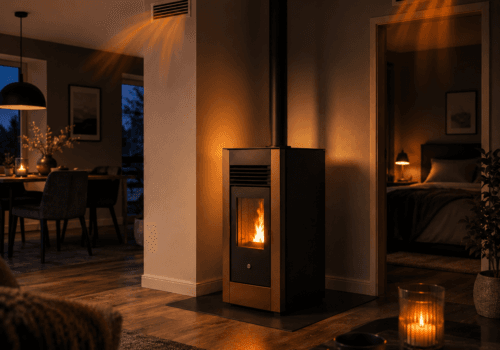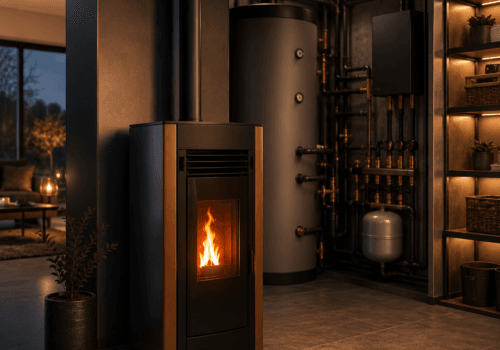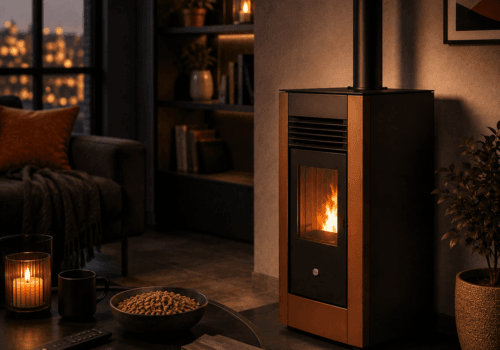


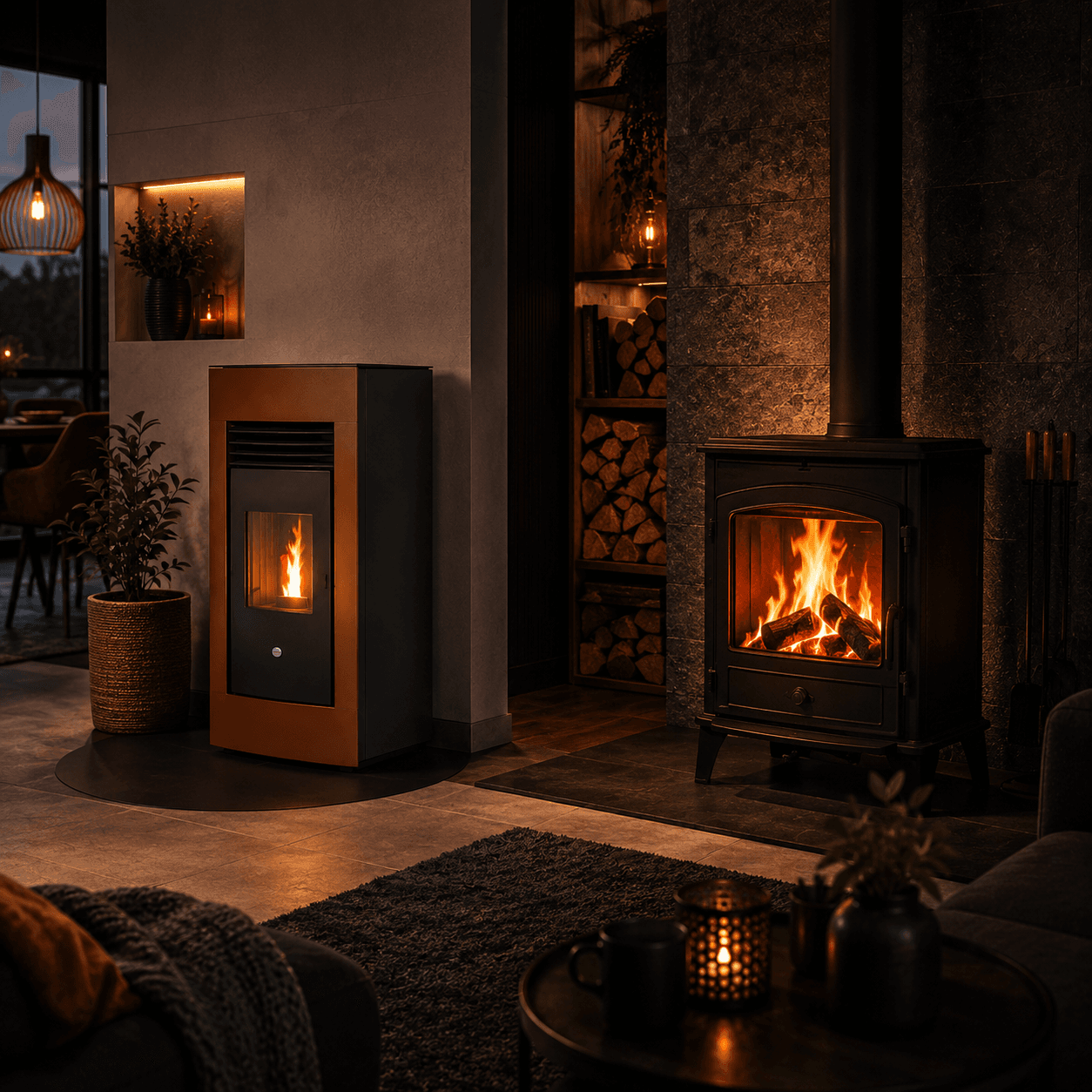
Pellet stove or wood-burning stove: the best choice depends mainly on how much comfort, automation, atmosphere and maintenance you think you’re important. A pellet stove operates automatically, is programmable and keeps the temperature fairly constant, but requires a mains socket and makes some noise due to the fan and auger. A wood-burning stove operates without electricity and produces a larger, natural-looking fire, but you have to add wood yourself and ensure you have sufficient dry storage space. Those who wish to heat their home on a daily and scheduled basis therefore often make a different choice to those who mainly use their stove occasionally to create a cosy atmosphere.
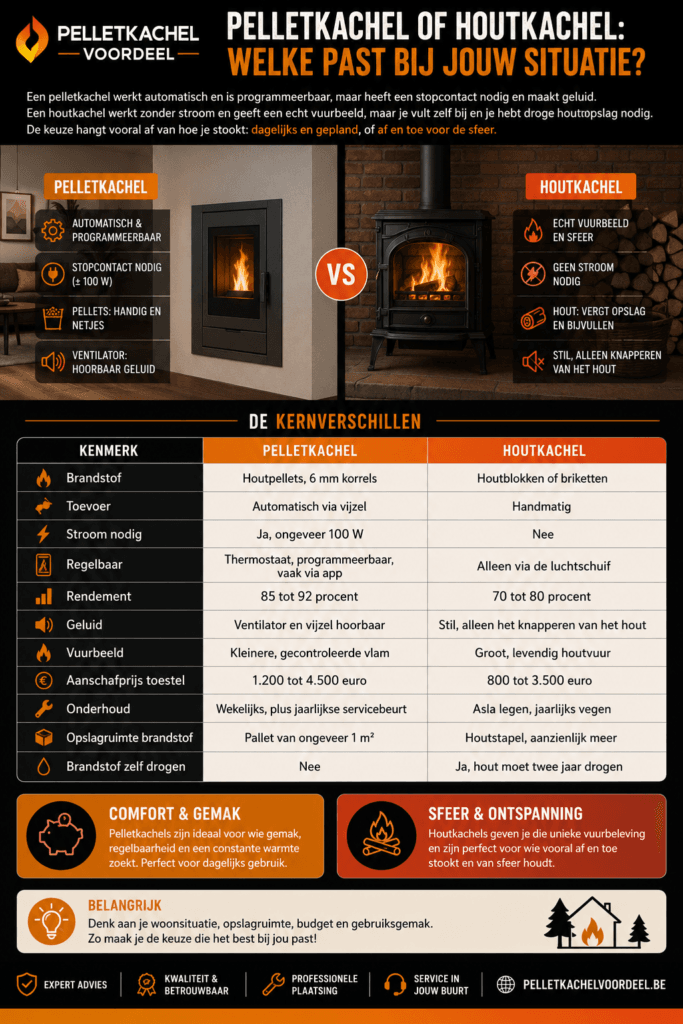
The key differences between pellet stoves and wood-burning stoves
| Pellet stove | Wood stove | |
|---|---|---|
| Fuel | Wood pellets, 6 mm granules | Logs or briquettes |
| Supply | Automatically via a screw jack | Manual |
| Need electricity | Yes, about 100 W | No |
| Adjustable | Thermostat, programmable, often via an app | Only via the air damper |
| Efficiency | 85 to 92 per cent | 70 to 80 per cent |
| Sound | Fan and screw pump audible | Silence, just the crackling of the wood |
| Fire scene | A smaller, controlled flame | A large, crackling log fire |
| Purchase price of the device | 1,200 to 4,500 euros | 800 to 3,500 euros |
| Maintenance | Weekly, plus an annual service | Never empty, sweep annually |
| Fuel storage area | Pallet measuring approximately 1 m² | Pile of wood, considerably more |
| Drying fuel yourself | No | Yes, wood needs to dry for two years |
Pellet stove or wood-burning stove: a cost comparison
| Post | Pellet stove | Wood stove |
|---|---|---|
| Device | 1,200 to 4,500 euros | 800 to 3,500 euros |
| Flue and installation | 800 to 2,500 euros | 800 to 2,500 euros |
| Fuel cost per kWh | about 9 to 10 cents | around 6 to 12 cents, depending very much on your source of wood |
| Electricity costs per season | 20 to 50 euros | 0 euros |
| Annual maintenance | more comprehensive, with more components | simpler |
The cost comparison depends entirely on your source of wood. If you can get hold of wood cheaply or for free and split and dry it yourself, heating with wood works out cheaper. If you have to buy oven-dried wood by the net, it works out more expensive than using pellets.
Ease of use: the factor that usually determines the choice
Ask yourself a specific question: Would you like to light a fire in the morning?
A pellet stove Start it at a programmed time, or via your phone whilst you’re in the car. By six o’clock, the living room will be at the right temperature without you having to do a thing. A wood-burning stove requires firelighters, kindling and twenty minutes to get going before it really starts to give off heat.
On the other hand, with a wood-burning stove, you simply throw in another log and that’s it. No electronics, no error messages, no circuit board that could break down.
Power cuts: the argument that is often overlooked
In the event of a power cut, a pellet stove will stop working. A wood-burning stove will simply carry on burning.
For most people, this is a theoretical point. For those who live in an area where power cuts are more frequent, or for those who regard their stove as a backup, it is a decisive factor. There are pellet stoves which operate without electricity, using natural draught, but which are more limited in terms of controllability and power.
Emissions and legislation in Flanders
Both aircraft must comply with the European ecodesign requirements. The regulations focus on the aircraft’s emissions, not on the fuel.
In practice, a modern pellet stove emits less particulate matter than a modern wood-burning stove, and considerably less than an old wood-burning stove or open fire. This is due to the controlled, constant combustion: a pellet stove continuously regulates the supply of fuel and air, whilst a wood-burning stove experiences peaks and troughs after each log is added.
The public debate on wood-burning focuses mainly on old stoves and open fires. For both types of modern appliance, the key is that they are correctly sized, used properly and serviced annually – this makes the biggest difference.
Decision table: which one is right for you?
| Your situation | Choice |
|---|---|
| You’re not at home during the day and want the house to be warm when you get back | Pellet stove, regarding its programmability |
| You can get wood for free or at a low cost | Wood-burning stove – the cost savings are considerable |
| You want to use the stove as your main source of heating | Pellet stove, for constant temperature control |
| You light a fire one evening a week to create a cosy atmosphere | Wood-burning stove – the view of the fire is the key |
| You don’t have much storage space | Pellet stove: a pallet takes up far less space than a pile of wood |
| You don’t want electronics or to be dependent on them | Wood stove |
| You experience power cuts | Wood stove |
| You live in a flat | Pellet stove, provided there is a suitable flue |
| You want to avoid noise | Wood stove |
| You want heating in several rooms | Pellet stove, ductable or connected to the central heating system |
Can you combine them?
Yes, and it happens more often than you might think. The pellet stove does the day-to-day work in the living room, whilst the wood-burning stove or insert is used at the weekend or during the festive season. Some people deliberately use the wood-burning stove as a backup in the event of a power cut.
There are also combination stoves that can burn both wood and pellets. These are rare and, in practice, represent a compromise: they do both reasonably well, but neither exceptionally well.
Take a look full range of pellet stoves or our wood stoves. For fuel, see pellets and wood briquettes. See also the difference between a freestanding pellet stove or built-in pellet stove
Frequently Asked Questions
What is the difference between a pellet stove and a wood-burning stove?
A pellet stove automatically feeds in compressed wood pellets and is programmable, but requires electricity. A wood-burning stove runs on logs that you load by hand, works without electricity and produces a larger fire.
Which is cheaper, heating with wood or pellets?
That depends on your source of wood. If you can source, split and dry your own wood, heating with wood works out cheaper. If you buy oven-dried wood by the net, it works out more expensive than using pellets, partly because of the lower efficiency of a wood-burning stove.
Which heater gives off more heat?
At the same nominal output, a pellet stove provides more useful heat, as its efficiency is 85 to 92 per cent, compared with 70 to 80 per cent for a wood-burning stove.
Can I burn pellets in a wood-burning stove?
Only with a special pellet basket that holds the pellets together. If scattered loosely, they fall through the grate and do not burn completely. Even then, the efficiency remains lower than in a proper pellet stove.
Is a wood-burning stove more environmentally friendly than a pellet stove?
Not usually. A modern pellet stove emits less fine particulate matter thanks to its controlled, constant combustion. With a wood-burning stove, there is a spike in emissions every time a log is added.
Is there a stove that runs on both wood and pellets?
Yes, but all-in-one devices are rare and represent a compromise. They do both things reasonably well, but neither is as good as a specialised device.