

What is the heat output of a pellet stove? do you have necessary for a a normally insulated house? Allow for approximately 0.08 kW per cubic metre of space to be heated. A living room measuring 40 square metres with a ceiling height of 2.5 metres would therefore require approximately 8 kW. With good insulation, this figure may be a third lower; with poor insulation, it may be a third higher.
That figure is more important than which make you choose. An incorrectly sized stove will perform poorly, no matter how good the appliance is.
The three-step calculation method
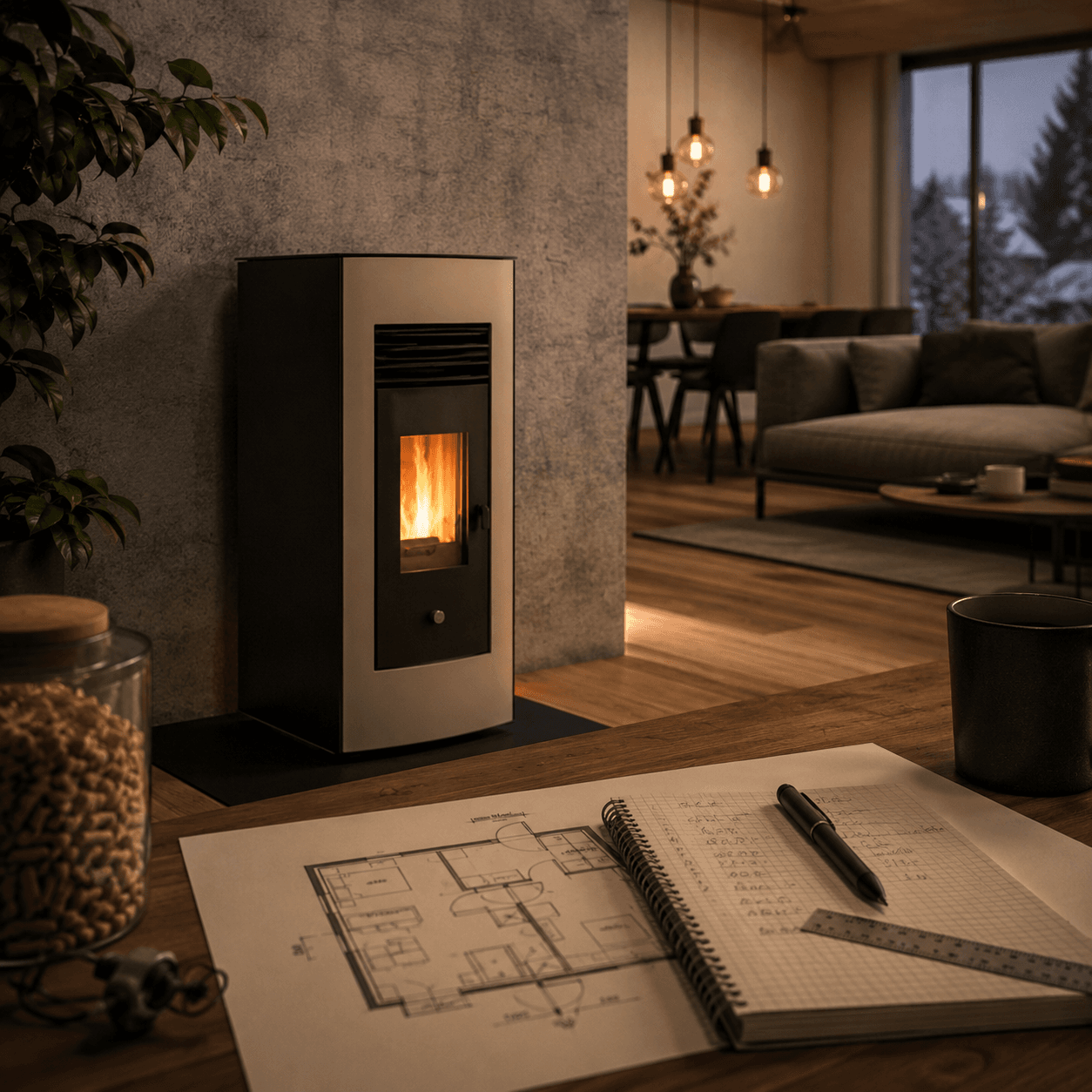
- Work out the volume. Area in square metres multiplied by the ceiling height. Only include the rooms that the heater actually needs to heat, but do include an open-plan kitchen or stairwell.
- Multiply by the insulation factor. Poorly insulated: 0.10, normal: 0.08, well insulated: 0.05 kW per cubic metre.
- Round off to the nearest unit, preferably downwards rather than upwards.
Example: a living room measuring 45 square metres with a ceiling height of 2.6 metres has a volume of 117 cubic metres. With standard insulation: 117 × 0.08 = 9.4 kW. A 9 kW unit is therefore more suitable than a 12 kW one.
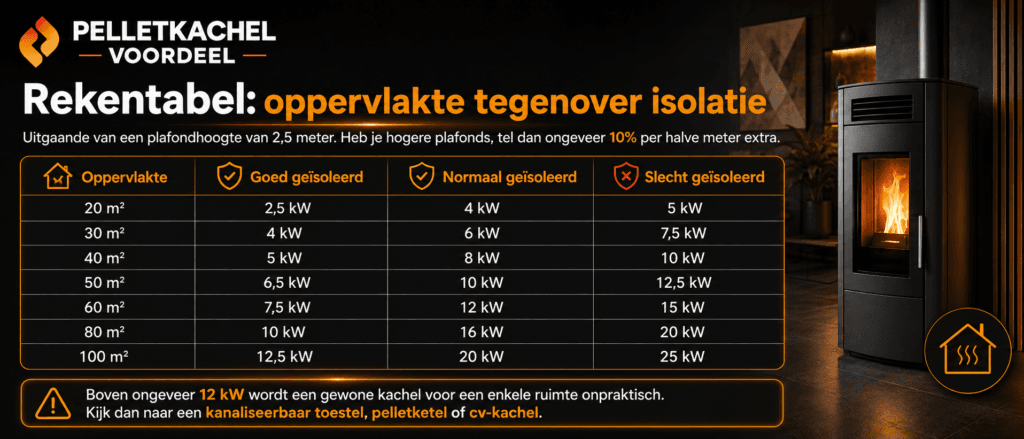
Calculation table: surface area versus insulation
Based on a ceiling height of 2.5 metres. If your ceilings are higher, add approximately 10 per cent for every extra half metre. You can calculate the area of multiple rooms here.
| Surface area | Well insulated | Normally insulated | Poorly insulated |
|---|---|---|---|
| 20 m² | 2.5 kW | 4 kW | 5 kW |
| 30 m² | 4 kW | 6 kW | 7.5 kW |
| 40 m² | 5 kW | 8 kW | 10 kW |
| 50 m² | 6.5 kW | 10 kW | 12.5 kW |
| 60 m² | 7.5 kW | 12 kW | 15 kW |
| 80 m² | 10 kW | 16 kW | 20 kW |
| 100 m² | 12.5 kW | 20 kW | 25 kW |
Above about 12 kW, a standard stove for a single room becomes impractical. In that case, you should look for a ducted unit or for pellet boilers and central heating stoves.
Why having too much wealth is worse than having too little
This is the most important sentence in this article, and most salespeople don’t say it.
A pellet stove has a modulation range: for example, it can operate from 2.5 to 9 kW. If you install a 12 kW unit (modulation range 4 to 12 kW) in a room that requires 6 kW, it will almost always run at its minimum output of 4 kW, which is still too much. The result:
- Incomplete combustion. The firebox wasn’t hot enough, so there was soot on the window and more ash.
- Pollute more quickly. The burner pot becomes encrusted, and the air holes become blocked.
- Higher consumption. A stove that burns inefficiently uses more pellets to produce the same amount of heat.
- More noise. The fan is running faster than necessary.
- Switching on and off. The heater reaches the desired temperature too quickly, switches off and then restarts. Each restart requires an ignition cycle.
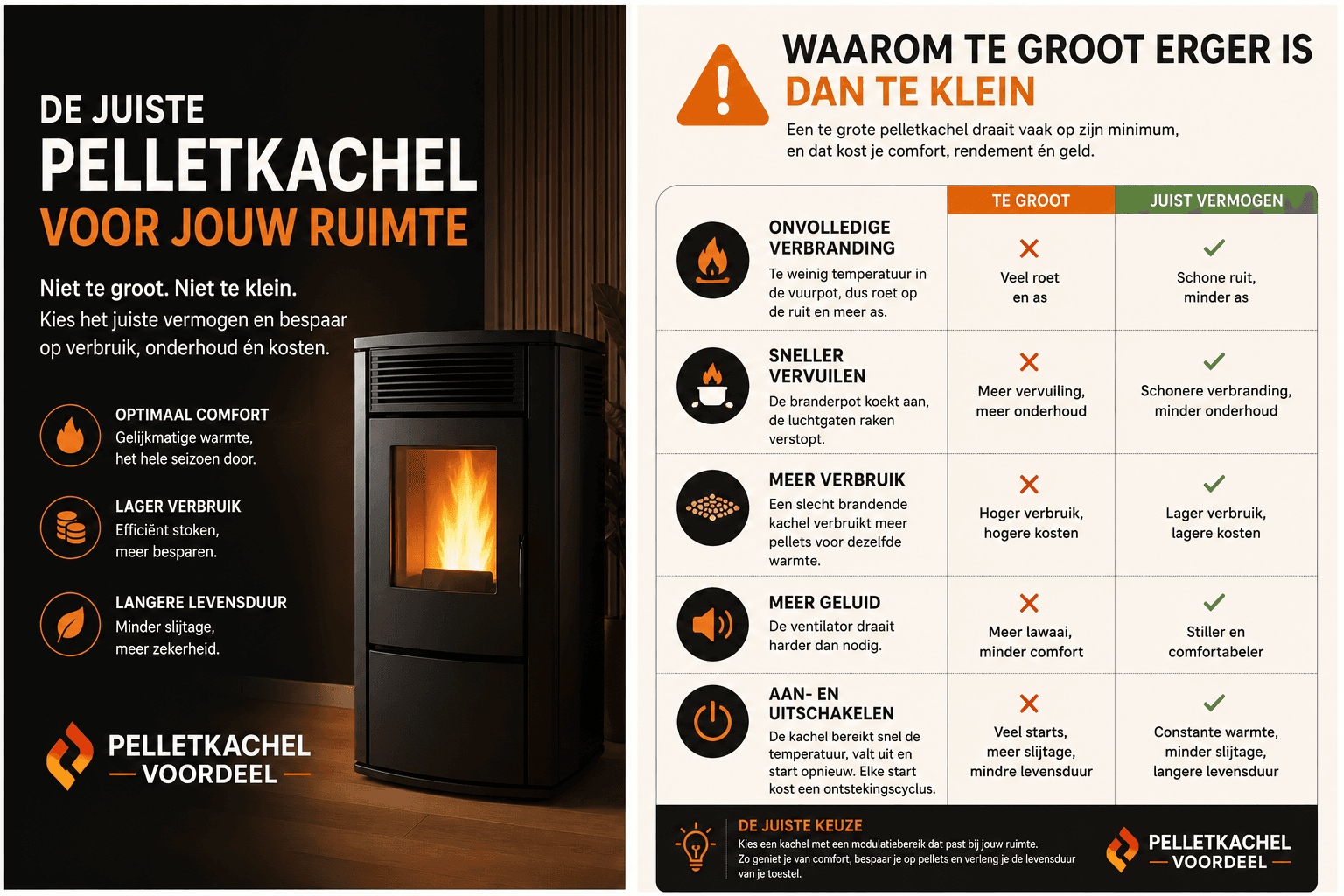
A stove that is just a little too small, on the other hand, runs constantly at a high, clean setting. It might not quite reach the desired temperature on the coldest days, but it performs better for the rest of the season.
The modulation range is just as important as the maximum
When comparing appliances, almost everyone looks at the maximum power rating. Make sure you check the minimum as well.
| Device | Range | Suitable for |
|---|---|---|
| Stove A | 2.4 to 8 kW | Suitable for spaces requiring 4 to 8 kW, highly versatile |
| Stove B | 5 to 8 kW | Only rooms that actually require 5 kW or more |
Both are 8 kW stoves, but A is suitable for a much wider range of situations. A wide modulation range means that the stove also works well in the mid-seasons, when you only need half the output.
Factors that adjust the calculation
Open or enclosed space
An open-plan kitchen, a mezzanine or an open staircase draws heat away. Take these volumes partly into account – roughly half for a stairwell and in full for an open-plan kitchen.
Windows and glazing
Single-glazed windows or large north-facing windows increase energy requirements by 10 to 20 per cent.
Year of construction as a rule of thumb
| Year of construction or renovation | Expect |
|---|---|
| Built before 1980, not renovated | 0.10 to 0.12 kW/m³ |
| 1980 to 2000 | 0.08 to 0.10 kW/m³ |
| 2000 to 2015 or refurbished | 0.06 to 0.08 kW/m³ |
| After 2015 or thoroughly re-insulated | 0.04 to 0.06 kW/m³ |
Supplementary heating or main heating
If you’re only using the stove as supplementary heating alongside an existing central heating system, you can safely go for a size smaller. If it’s your main source of heating, then use the full calculation.
Three examples worked out
Terraced house, living room with open-plan kitchen, 55 m², built in 1975, double glazing
55 × 2.6 = 143 m³. Standard insulation after fitting double glazing: 143 × 0.09 = 12.9 kW. That is a lot for a single stove: a ducted unit of 10 to 12 kW would make more sense here, or additional retrofitting of insulation before purchase.
Flat, living area 35 m², built in 2010
35 × 2.5 = 88 m³. Good insulation: 88 × 0.06 = 5.3 kW. A 5 or 6 kW heater will suffice. An 8 kW heater would have to run continuously at minimum power here.
Detached house, living area 70 m² with mezzanine, built in 1965, not retrofitted with insulation
70 × 2.5 = 175 m³, plus half the loft space – let’s say 200 m³. Poor insulation: 200 x 0.11 = 22 kW. A single stove won’t be able to cope with that. In this case, you’ll need to consider a central heating pellet stove or pellet boiler, or insulate the property first.
Which appliance is suitable for which power rating?
| Power | Type | View |
|---|---|---|
| 4 to 7 kW | A small or narrow stove for a single room | narrow pellet stoves |
| 7 to 10 kW | Standard freestanding or built-in stove | built-in pellet stoves |
| 10 to 14 kW | Ducted system for multiple rooms | full range of pellet stoves |
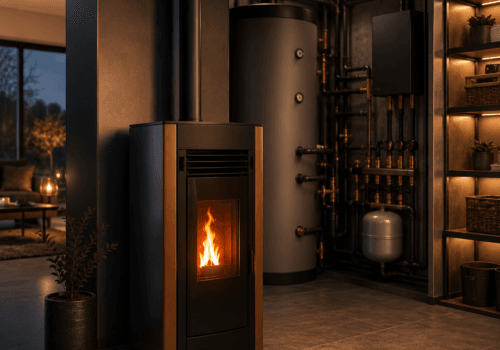
| 14 kW and above | Central heating pellet stove or pellet boiler | pellet boilers and central heating stoves |
For advice on the installation and sizing of the flue, please contact Pellet Stove Care.
Frequently Asked Questions
What size pellet stove (in kW) is needed for 100 m²?
With standard insulation, around 20 kW; with good insulation, around 12.5 kW. That’s too much for a standard room heater: for 100 square metres, you’ll need a ducted unit or a central heating pellet stove.
Is 10 kW enough for my living room?
For a normally insulated room of around 50 square metres with a standard ceiling height, 10 kW is suitable. For a smaller room, this is too much and the stove will run continuously at minimum power.
What happens if my pellet stove is too big?
It runs continuously at its lowest setting, which leads to incomplete combustion, soot on the window, more ash, a burner pot that becomes dirty more quickly, more noise and higher pellet consumption than expected.
Can a pellet stove heat several rooms?
Yes, with a ducted system that channels some of the warm air through ducts to other rooms. You can expect to heat one to three additional rooms with approximately six to eight metres of ducting.
What is the modulation range of a pellet stove?
The difference between the minimum and maximum power at which the appliance can operate, for example 2.4 to 8 kW. The wider that range, the better the stove adapts to fluctuating outside temperatures.
Do I need to adjust the power rating when I’m insulating?
Yes. Following thorough retrofitting with insulation, the heating requirement can be reduced by between a third and half. If you’re planning to carry out insulation work within the next few years, you should choose a boiler with a low minimum output now.